
The Goddess
The sanskrit word Kundalini is rooted in kund– to burn; and kunda, to coil or to spiral. Kundalini is depicted as the primordial un-manifested or potential life force resting in 3 and a half coils at the base of the spine and is symbolised by a coiled resting serpent.
The Goddess represents or contains this universal primordial creative force- shakti (power). She is Prakriti, the female divine energy or manifested expression of consciousness-Purusha. Without the feminine divine principle, there is no material existence as everything in this physical reality is attributable to her. She is the void of creation, the potential for life, the cosmic womb, creation and every little living or non-living being contained within it. Her shakti or potential power lies at the root chakra, guarded by a liminal deity Ganesha, the son of shakti, born from her flesh.
In Tantra, she is symbolised by the coiled serpent lying at the base of our spine at a location known as Mooladhara chakra. This chakra is not a physical wheel but rather a spot where nerve centers meet to create potential energy. When the energy is released, or in esoteric terms, when the serpent rises- she uncoils and begins ascending through the chakras until she pierces through the Sahasrara chakra to initiate the process of enlightenment. Rising of kundalini is the awareness of this shakti, this feminine principle who awakens and transcends from “I am of earth” to “I am the cosmos/brahman”
Muladharaika nilaya bramhagrandhi vibhedini
manipurantarudita vishnugrandhi vibhedine – 38
Aagyna-chakrantaralasdha rudra-grandhi vibhedini
sahasraranbujaruda sudhasarabhivarshinee – 39
Tatillata samaruchi shatchakropari sansdhita
mahashakti-kundalini bisatantu taniyasi – 40
The verses 38, 39 and 40 in Lalitha Sahasranamam (1000 names of the Goddess) attribute the Goddess with the primordial life force (kundalini) energy that rests at the Mooladhara chakra in every human being. Which when awakened, rises through the Manipura+ Anaharta chakra (Vishnu granthi), and the Aagya + Sahasrara chakra (Rudra granthi) to achieve enlightenment. In other words, the feminine divine principle(prakriti) rises to meet and merge with the masculine divine principle (Purusha). From all that I read and understood on Kundalini (which is a drop in the ocean admittedly), theoretically, it would seem that without invoking the feminine divine principle, there is no enlightenment (however one wishes to describe it).
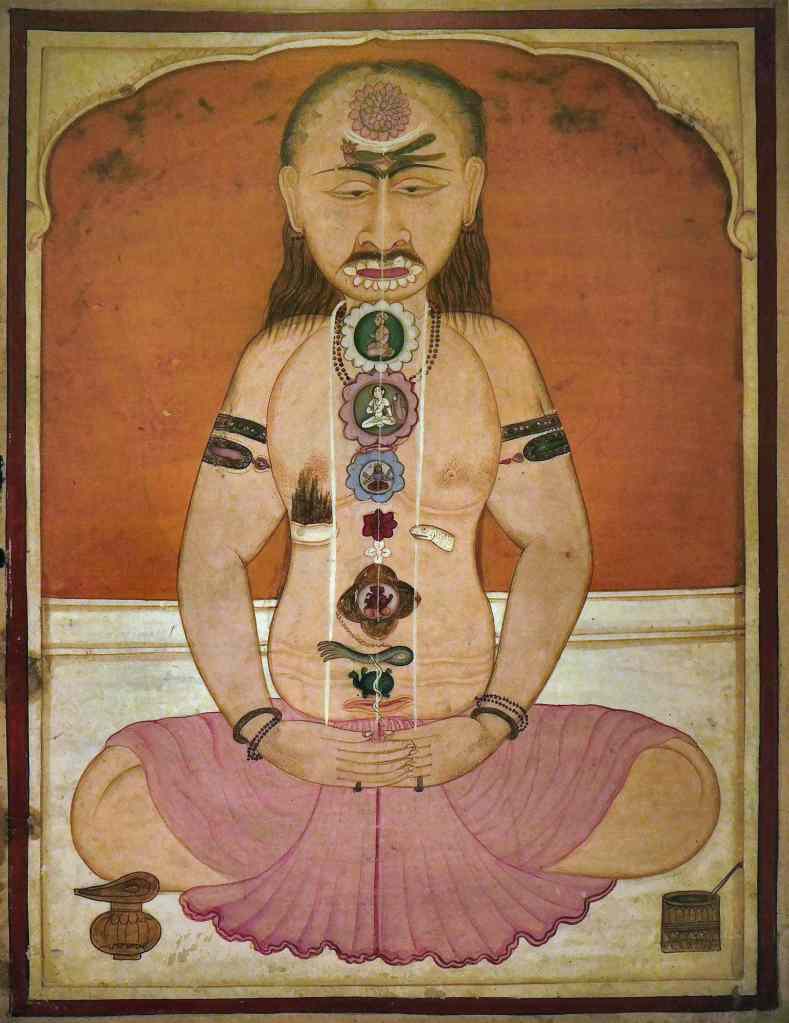
In yoga (non-tantric texts) the rising of the serpent is symbolised by 2 nadi’s or energy pathways or channels- ida and pingala. These two naadi’s curve along the length of our spine (Sushumna nadi). The ida nadi is governed by the Moon (feminine) and the Pingala nadi is ruled by the Sun (Masculine). Simply put, ‘praana’ or life force runs through these dual and opposing channels and when the dual energetic life force are perfectly balanced, it activates the Sushumna nadi and enlightenment is the effect.
Kundalini Awakening Experience.
Highly personal and subjective
From all that I’ve read, Kundalini seems to be an intensely personal and highly subjective experience. No two accounts are alike and most of the evidence is anecdotal at best and fraudulent at worst. Some, like Gopi Krishna, liken it to a thunderbolt or cracking sound.
“Suddenly, with a roar like that of a waterfall, I felt a stream of liquid light entering my brain through the spinal cord. The illumination grew brighter and brighter, the roaring louder, I experienced a rocking sensation and then felt myself slipping out of my body, entirely enveloped in a halo of light. It is impossible to describe the experience accurately..”
Gopi Krishna.
Typing in kundalini awakening in a search engine will pull up hundreds of pages referring to this mystical and intimate experience. Some claim to have had a sudden spontaneous kundalini awakening from ingesting mind altering substances while others describe it as a byproduct of intensive meditative practice.
Who to believe and to what extent?
I leave you to judge the authenticity of the claims. What is certain is that a kundalini awakening is just the beginning of what is commonly referred to as a ‘spiritual path’ and not the destination.
Depression or existential crises
What truly happens to the human mind after a powerful experience? It’s likely one feels completely destabilised. Rudderless, confused and disoriented. Like the rug has been pulled out from under our feet. Like nothing in the world makes any sense at all.
When described like this, anybody who has experienced trauma of any sort will recognise that the symptoms of kundalini awakening seem awfully similar to PTSD. As with a life changing event, this spiritual experience burns the ‘old version’ off and a new version is birthed.
The unveiling of the ‘you 2.0’ is not easy. As with any metamorphosis, the process of rebirth, so to speak, is riddled with false starts, illusions and delusions. It takes a strong mind and an even stronger heart to filter out the noise, the irrelevant information that begins to descend after a kundalini awakening. A few who have experienced it have described it as a condition very similar to psychosis.
In spiritual alchemy, the process in which one sheds the sum total of our past conditioning and programming is called Nigredo or blackening, also known in new age circles as ‘the dark night of the soul‘. During this process, one attempts to integrate our light (or Ida or conscious or masculine principle) with the shadow (Pingala or subconscious or feminine principle). What this means in practical terms is that we might begin to address and heal our traumas and/or take accountability for our mistakes, regrets, blunders and all those undesirable traits which we usually project on others.
Self Integration or ‘Aham Brahmasmi’
If navigated successfully, the nigredo (blackening) stage seamlessly transforms to ‘albedo’ or the whitening. Literally where we wash away our impurities and emerge purified. What this could indicate is ‘illumination’, or bringing the hidden (subconscious) to light (conscious). We begin to question why-we-do what-we-do in Nigredo and we understand and accept why-we-do-what-we-do in Albedo.
It can also be described as moving from a ‘duality’ thought patterns (me and you, black and white etc) to a non-dual perception of the world. Where one sees everything and everyone as an extension of the divine and understands that any separation between one object and another is an illusion.
In mystical terms, one acknowledges “I am divine” (Brihadaranyaka Upanishad). Or that duality is an illusion because each of us is a manifested expressions of divinity. In other words, ‘you‘ is just ‘another me’
A fully realised or self-actualised person may be symbolised by the ‘Rubedo’ or redness- the emergence of a coherent and cohesive sense of self marked by mental and emotional stillness from lack of internal conflict. But, one must continue living and breathing and doing all the things that make us human. So as the zen proverb goes, before enlightenment chop wood, carry water. After enlightenment chop wood, carry water.
REFERENCES
Please note that I do not endorse the views in the reference material. I’m not a disciple of Om Swami or Gopi Krishna or any of the authors listed below. It is advisable to read extensively on your own and form your own opinions on this very mystical experience.
Kundalini: An untold story, Om Swami
Kundalini: The evolutionary energy in man, Gopi Krishna
Aghora I: At the left hand of god, Robert Svoboda.
Aghora II: Kundalini, Robert Svoboda
Anatomy of Spirit, Carolyn Myss
Serpent Power- Sir John woodruff.
Kundalini: A Modern view, Darrel Irving
 umbarta.com